LPG — Light Pattern Generator: Stable Waveguide Test Source
The LPG Light Pattern Generator is a calibrated, compact and self-contained RGB projection light source, developed and manufactured by TechnoTeam. It is designed specifically for characterizing augmented-reality (AR) waveguides for near-eye display devices and other optical systems. The LPG delivers monitored and controlled luminances with a maximum above 5 Mcd/m² (85 % white), a usable 47° flat field of view with focal plane at infinity, and a customer-configurable 2–4 mm exit pupil — directly compatible with waveguide input coupler geometries.
The LPG closes a critical gap in the waveguide testing toolchain: a stable, calibrated, controllable projection standard that enables reproducible and directly comparable measurements across laboratories, supplier sites, and production lines.
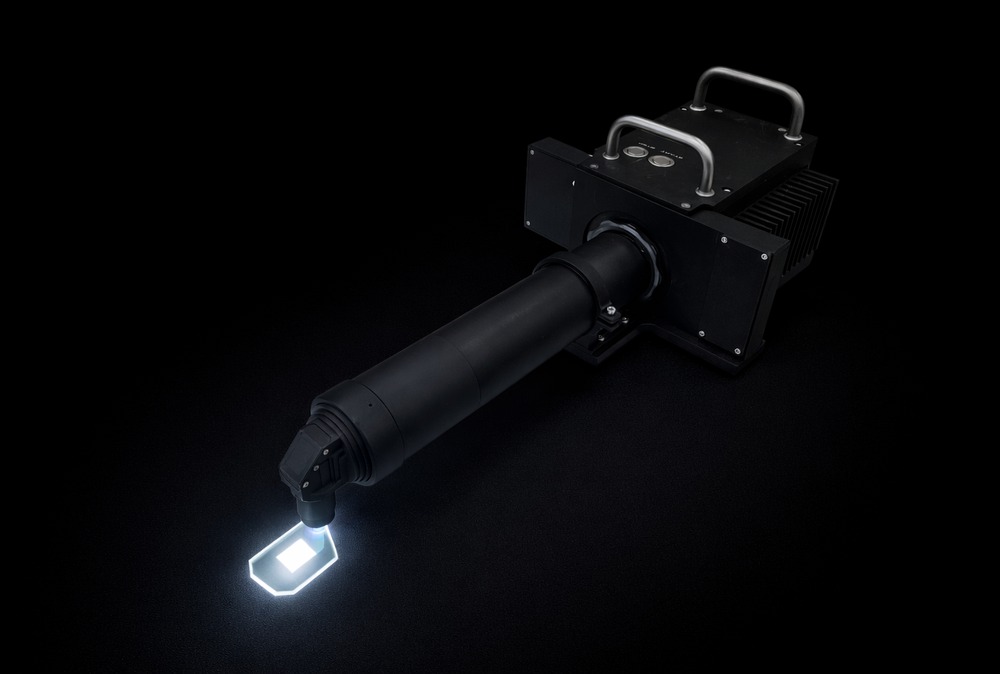
At a Glance — Why the LPG Is Built for Waveguide Testing
- Stable output across time, spectrum and luminance levels — the core property: temporal stability, defined spectral primaries, adjustable luminance and color output.
- >5 Mcd/m² max. luminance (85 % white) — headroom for low-coupling-efficiency waveguides.
- Independent current and PWM control for each R, G, B high-power LED module.
- 47° usable flat field of view with focal plane at infinity — matches AR waveguide input-coupler optics.
- Customer-configurable 2–4 mm exit pupil, 1–3 mm in front of the last optical surface.
- Geometric field distortion below 5 % across the full image field.
- Six-position motorized test pattern (reticle) slider for customer-defined test patterns.
- SCPI over USB-C, programmable sequencer and LEMO trigger I/O — drop-in automation with TechnoTeam LMK ILMDs and production-line handlers.
- Live photometric monitoring and control of illuminance, chromaticity (x, y), CCT, LED currents and thermal status; CIE 1931 (x, y) and CIE 1976 (u′, v′) diagrams.
- Multi-language GUI: English, Deutsch, 한국어, 中文.
Why a Stable Standard Light Source for Waveguide Testing?
Waveguides for AR near-eye-displays are moving rapidly toward volume production. As production scales, the demand for reproducible, traceable optical test sources grows sharply. Conventional waveguide test rigs use common image pattern projection sources or display-based image sources — and these are, in most cases, not stable enough for quantitative waveguide metrology.
Three stability gaps in display- and projector-based setups:
- Temporal stability — common projectors drift during warm-up and across operating hours, so measurement readings depend on when the test was run.
- Spectral stability — LED and laser illumination in common projectors shifts with temperature and drive level, biasing colorimetric results.
- Low-frequency flicker and PWM artefacts — display-sourced test patterns introduce low-frequency flicker that couples into short-exposure ILMD captures.
The LPG is engineered to close those gaps. It is a dedicated, calibrated projection standard with independent current and high frequency PWM regulation per RGB channel, thermal monitoring, and a defined exit-pupil geometry. Results captured with any ILMD behind the waveguide are directly comparable between systems, laboratories, and production lines.

Applications
AR waveguide characterization — R&D and incoming production line inspection. Luminance uniformity, contrast, stray light, chromatic performance, and coupling-efficiency measurements on single- and multi-layer waveguides — with traceable, reproducible input illumination.
Near-eye display (NED) optical testing. Standardized reference input for AR, VR, MR and smart-glass components.
Production-line quality control. Sequencer, LEMO trigger I/O and SCPI API make the LPG drop-in for automated end-of-line inspection; cycle times are limited only by the measurement camera.
Cross-laboratory benchmarking. A calibrated, stable reference makes results captured at supplier and OEM sites directly comparable — enabling consistent performance evaluation across the supply chain.
Control, Automation & Sequencer
The LPG is controlled via SCPI commands over USB-C at 115 200 Baud, with either a graphical user interface (GUI) or direct SCPI commands. Live monitoring covers luminance (cd/m²), chromaticity coordinates CIE 1931 (x, y) or CIE 1976 (u′, v′) and the correlated color temperature.
A programmable sequencer lets users create, save, and replay automated light-level and test-pattern sequences — from the GUI, via SCPI, through the front-panel Start and Step quick-access buttons for hands-on operation or using trigger signals.
The GUI is available in English, Deutsch, 한국어 and 中文.
A LEMO-connectorized trigger I/O can control the LPG sequencer directly from test equipment for end-to-end automated inspection. See — Interfaces & Connectors for pin-out.
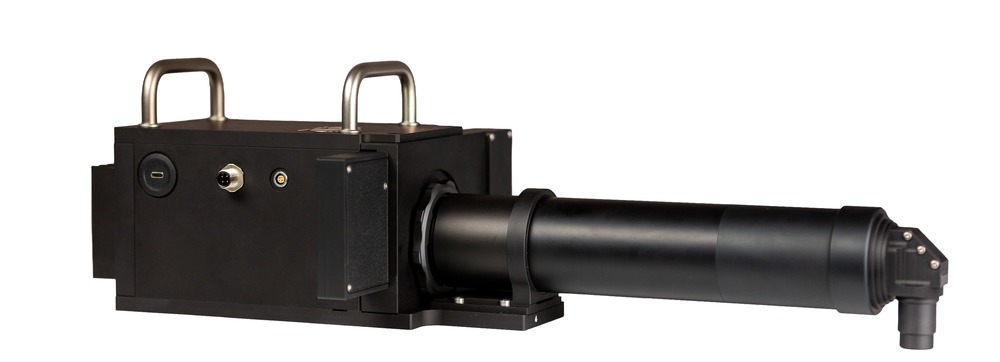
Technical Specifications
| Category | Value |
|---|---|
| Type | Calibrated and self-contained RGB projection standard light source |
| Light source | 3 × independently controlled high-power LED modules (R, G, B); combined current and PWM regulation |
| Maximum luminance | > 5,000,000 cd/m² (85 % white) |
| Color primaries | R, G, B primaries — customer-configurable |
| Contrast ratio | See FAQ section |
| Usable field angle | 47° flat field, focal plane at infinity |
| Max. geometric field distortion F(θ) | < 5 % over full image field |
| Exit pupil diameter | 2–4 mm, customer-configurable |
| Exit pupil position | 1–3 mm in front of the last optical surface, customer-configurable |
| Test patterns | 6 positions via motorized reticle slider — customer-defined |
| Control interface | SCPI over USB-C, 115 200 Baud (GUI + API) |
| Automation | Programmable sequencer; LEMO trigger I/O for direct LPG sequencer control; front-panel Start / Step |
| Live monitoring | Luminance (cd/m²), chromaticity CIE 1931 (x,y), CIE 1976 (u',v'), CCT |
| GUI languages | English, Deutsch, 한국어, 中文 |
| Dimensions (L × W × H) | 660 × 240 × 162 mm |
| Weight | 6.7 kg |
| Power supply | 24 V DC, 5 A |
| User I/O | 2 × inputs (Start, Step; 1.8–6 V, max. 10 mA) + 1 × open-collector output (max. 24 V / 10 mA) + common GND |
Interfaces & Connectors
| Interface | Connector | Electrical / pin-out | Purpose |
|---|---|---|---|
| Software control / data | USB-C | Serial SCPI @ 115 200 Baud | GUI + API, firmware updates, serial monitor |
| Power supply | BINDER | 24 V DC / 5 A. Pin 1: +24 V · Pin 2: +24 V · Pin 3: 0 V · Pin 4: 0 V | DC input for LED modules and electronics |
| User I/O (trigger) | LEMO | Pin 1: Input 1 — Start (1.8–6 V, max. 10 mA) · Pin 2: Input 2 — Step (1.8–6 V, max. 10 mA) · Pin 3: Output 1 — open-collector (max. 24 V / 10 mA) · Pin 4: Ext. GND / common | Trigger sequence start and step-forward; status |
| Projection lens | TechnoTeam lens bajonet mount | — | Interchangeable projection lens; exit pupil 2–4 mm customer-configurable |
| Front-panel buttons | Start / Step push-buttons | — | Manual run / step of sequencer without PC |
| Interface | Connector |
|---|---|
| Software control / data | USB-C |
| Power supply | BINDER |
| User I/O (trigger) | LEMO |
| Projection lens | TechnoTeam lens bajonet mount |
| Front-panel buttons | Start / Step push-buttons |
Request a Consultation or Live Demo
Specifying a waveguide test setup, scaling a near-eye display production line, or comparing test source options? Our AR/VR measurement team will help you choose the right LPG configuration — exit pupil, reticle patterns, and lens — and can arrange a live demo in Ilmenau or at your site.
FAQ — Light Pattern Generator
The LPG is a monitored, controlled and calibrated RGB projection standard light source for optical characterization of AR waveguides for near-eye display devices and similar systems with defined input apertures. It enables reproducible luminances, contrasts, uniformity and color measurements in R&D, supplier inspection, and production line environments.
Common projectors are typically not long-term stable enough for quantitative waveguide metrology — they drift during warm-up, shift spectrally with temperature, and introduce low-frequency flicker. The LPG is engineered for temporal, spectral, and drive-level stability, which is the basis for reproducible waveguide measurements.
Maximum luminance is above 5 Mcd/m² (white, 85 % PWM) — orders of magnitude beyond typical LCD or OLED test displays. This headroom is essential for waveguides with low coupling efficiency.
The LPG exit pupil is customer-configurable between 2 mm and 4 mm, positioned 1–3 mm in front of the last optical surface. The focal plane is at infinity and the usable flat field is 47°, with geometric field distortion below 5 %.
The LPG produces high-contrast test patterns suitable for AR waveguide and near-eye-display measurements. Actual contrast depends on the chosen test pattern, the image position on the field, and the active RGB channel. Contact us to get an estimation for your scenario.
Via SCPI commands over USB-C at 115 200 Baud. The multi-language GUI (English, Deutsch, Korean, Chinese) provides live monitoring of luminance, chromaticity CIE 1931 (x,y), CIE 1976 (u'v'), CCT. The programmable sequencer and a serial monitor round out the software feature set.
Yes. SCPI over USB-C, the programmable sequencer, the motorized reticle slider, and the LEMO trigger I/O are designed for hands-off automated inspection. The LPG pairs particularly well with TechnoTeam LMK ILMDs such as the LMK 6 series with NED lenses.
Six customer-defined patterns — typical examples include an open aperture, dot matrix, sparse and dense checkerboards, a coarse checkerboard, and MTF test patterns.
RELEVANT PRODUCTS AND APPLICATIONS

- Type:
- Hardware
- Applications:
- Display Light sources & luminaires
- Measurands:
- Color measurement Light measurement
- Tasks:
- Automation & Industry Development & Industry